

Welcome to New Jersey Insight, a periodic newsletter to make law and politics (through a New Jersey lens) more accessible.
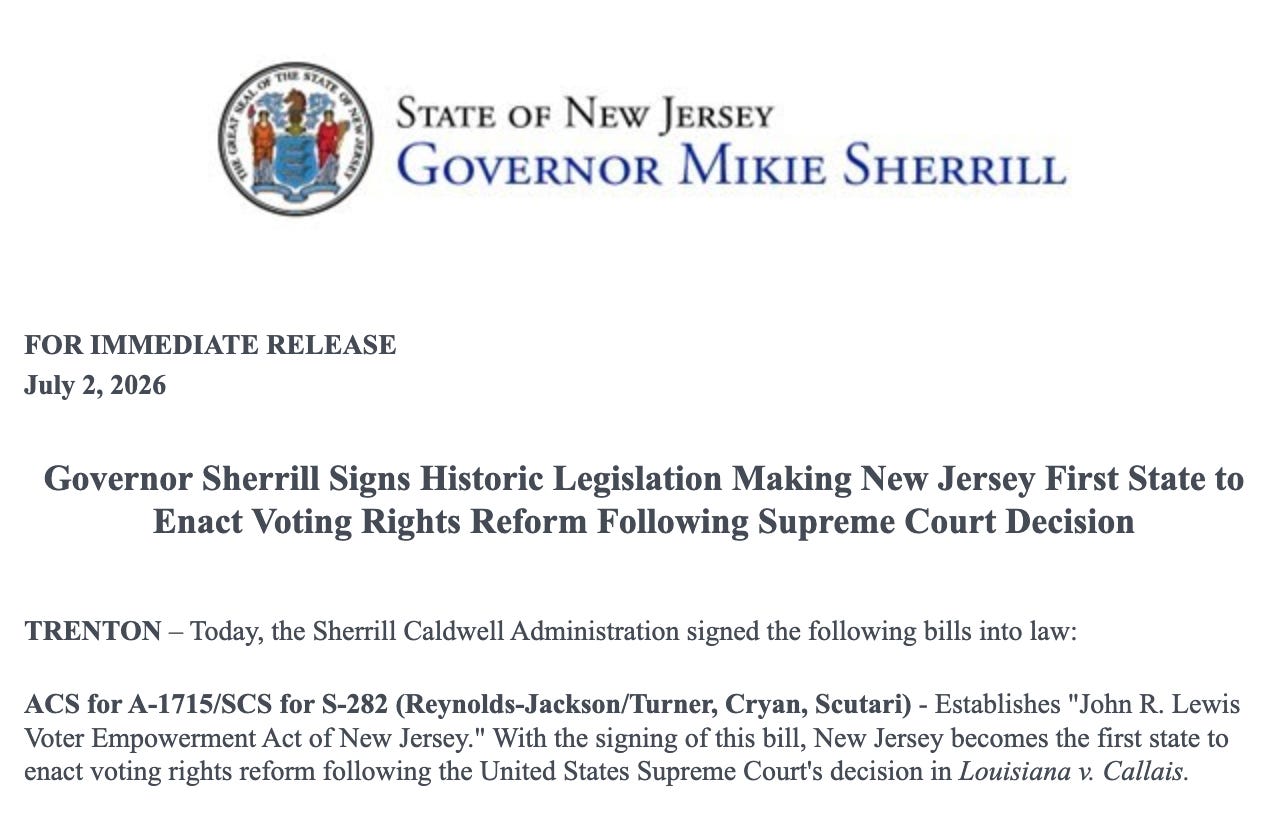
On the 250th anniversary of this nation’s founding, instead of adopting a myopic view of democracy, New Jersey chose an empowering one. The Legislature passed, and Governor Mikie Sherrill signed, the John R. Lewis Voter Empowerment Act. New Jersey is the first state to enact voting rights reform following the disappointing decision by the U.S. Supreme Court in Louisiana v. Callais. Many thanks to Assemblywoman Verlina Reynolds-Jackson and organizations like the ACLU of New Jersey, AAPI New Jersey, and the National Institute for Social Justice for their relentless advocacy in making the Act a reality.
The law is designed to maximize voter participation. It prohibits voter suppression and voter dilution measures. It requires meaningful language access measures that build upon Section 203 of the federal Voting Rights Act.
This is much welcomed news at a time when the very essence of American identity is in question. Some view it narrowly. They espouse efforts to limit who can be a citizen by birth, expand who can be stripped of their naturalized citizenship, and restrict who can vote. These attempts are not new. History is replete with examples of how this country struggled to determine who exactly is, or should be, an American, and who gets a say in defining the United States.
Now, 250 years later, I don’t think the country is any closer to resolving the question. But in the words of Dr. King, I am optimistic that—in the long arc of history—the nation is moving toward justice. The Supreme Court’s decision to uphold birthright citizenship and New Jersey’s choice to strengthen democracy are steps toward that vision. But let’s be clear. More work remains.
I’ll end with a passage that I wrote over six months ago about American identity:
For me, when I think of American identity, I think of the story of my parents first arriving in the United States from Bangladesh at the dawn of this nation’s bicentennial. I think about the story of my wife’s parents, who fled the ravages of the Khmer Rouge genocide in Cambodia and arrived here as refugees, ultimately becoming naturalized citizens, and working tirelessly to become mainstays in their community as small business owners while raising two children. I think about a one-year-old me accompanying my parents to a federal courthouse over forty years ago where they raised their hands to pledge their exclusive allegiance to the Constitution and laws of the United States.
The Nation was founded on aspiration, which continues to be deeply ingrained in our culture. Whether those who arrived here recently, those who were born to immigrants or refugees, those descended from enslaved ancestors, or those who have a different lineage—we are all part of the American identity.