

It’s the end of the year. The holiday season is in full swing. And in between holiday activities,1 I’ve been reflecting.
This past year has brought a lot of...change.2 In 2025, we have witnessed a widespread shift in politics and culture. Through them all, one thread appeared frequently: the question of American identity. As we enter the 250th anniversary of this nation’s founding, we have yet to settle it. Who is an American?
In 1776, Thomas Jefferson started to define it. One who believes that all [men] are “created equal” with certain “unalienable Rights,” and among those are “Life, Liberty and the pursuit of Happiness.” Nearly a hundred years later, upon the suggestion of U.S. Senator Jacob Howard of Michigan, the nation amended its founding charter to define an American citizen as one “born or naturalized in the United States, and subject to the jurisdiction thereof.”
Jefferson’s conception of an American started with a set of core values. The U.S. Constitution later delineated who can be a citizen, but without an explicit reference to those core values. The law today fills in some of those gaps, but only for the naturalization process. A foreigner who wishes to naturalize must promise to “support and defend the Constitution and laws of the United States” and possess “good moral character,” among other things, but the same is not required for someone merely born here. Yet both are American citizens.
Therein lies some of the tension. If a foreigner who is eligible to naturalize and become a citizen, but refuses to support the Constitution or does not have “good moral character,” they obviously should not be able to naturalize under current law. In contrast, if a person who is born in the United States and later espouses a set of beliefs that runs counter to basic constitutional principles (or does not have “good moral character”), they would likely enjoy First Amendment protections without any concern that their citizenship would ever be called into question.3
Today, the question of American identity is a prominent feature of our politics. With rapid changes in immigration policy, the current administration is narrowing the pathways for immigrants to arrive in the United States and to remain here. For those who are present in this country, the government is endeavoring to narrow the ambit of children who would be entitled to birthright citizenship despite the plain meaning of the Constitution. For naturalized citizens, the government now plans to increase its efforts to strip foreign-born Americans of their citizenship, representing a “a massive escalation of denaturalization in the modern era.”
And just several months ago, the current Vice President of the United States suggested that mere “agreement with the creedal principles of America” would be insufficient to be an American because it is both “overinclusive and underinclusive.” In his view, such a standard would include countless foreigners but reject “a lot of people the ADL would label domestic extremists, even though their own ancestors were here at the time of the Revolutionary War.”4
He then went on to create a straw man in New York City Mayor-elect Zohran Mamdani (along with the undefined “Left”) and demanded that individuals like Mamdani ought to have “gratitude for this country.”
A lot to say in response. But I’m most troubled by the Vice President’s implication that immigration and American identity are mutually exclusive (history tells us otherwise) and that, somehow, those with a long ancestral lineage in the U.S. has a superior claim to American identity than others. In other words, some are more worthy Americans, and others are less worthy. Such distinctions, in my view, are profoundly wrong and run counter to a fundamental American principle: equality under the law.5
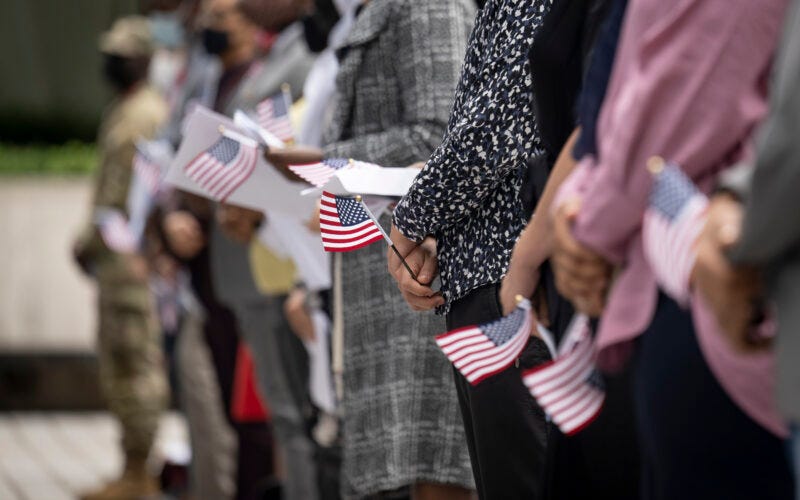
For me, when I think of American identity, I think of the story of my parents first arriving in the United States from Bangladesh at the dawn of this nation’s bicentennial. I think about the story of my wife’s parents, who fled the ravages of the Khmer Rouge genocide in Cambodia and arrived here as refugees, ultimately becoming naturalized citizens, and working tirelessly to become mainstays in their community as small business owners while raising two children. I think about my parents appearing in a federal courthouse over forty years ago in Oklahoma City with a one-year old (me) and raising their hands to pledge their exclusive allegiance to the Constitution and laws of the United States.
In the end, no one path holds a monopoly over the American identity. Whether those who arrived here recently, those who were born to immigrants or refugees, or those who have a long lineage - they all have their American story and American identity.
This reminds me of James Baldwin, who echoed a sentiment from Henry James: “It is a complex fate to be an American.”
Yes it is. I hope all of you have a restful holiday season, and happy new year.
Honestly, I’ve lost count on the number of parties/events/etc. that the family and I have attended.
The understatement of the year.
To be clear, for individuals that do not possess “good moral character,” they may suffer legal consequences if they act in violation of the law - regardless of their own personal beliefs.
J.D. Vance, “American Statesmanship for the Golden Age,” https://americanmind.org/salvo/american-statesmanship-for-the-golden-age/.
In remarks during Turning Point USA’s annual national conference yesterday, the Vice President reportedly said that Minnesota State Senator Omar Fateh had been “a candidate for mayor of Mogadishu. Wait, I mean Minneapolis.” This follows repeated attacks from the President against the Somali American community. Such rhetoric is not only abhorrent and unbecoming of any elected leader, let alone the president and vice president, but they are also incredibly dangerous.