

Welcome to New Jersey Insight, a periodic newsletter to make law and politics (through a New Jersey lens) more accessible.
Remember the days when you looked forward to receiving the mail? I do. Whether it was a letter from a distant friend, a birthday card from a relative, or a holiday card from a loved one, the mail channeled the best of humanity and kept relationships alive. I never would have a imagined that the mail—a neutral player in the world of communications—would now want to be the arbiter of democracy.
I wish that I was exaggerating.
On Friday, August 21, 2026, the U.S. Postal Service finalized a 95-page rule implementing pieces of President Trump’s March 2026 executive order on elections. The rule is remarkable. If implemented, it would require states to upload the names and home addresses of every voter requesting a mail ballot into a federal portal before USPS will carry that ballot. If a voter does not appear on the USPS database, USPS will refuse to deliver the ballot. The states would also have to design new vote-by-mail envelopes to comply with new federal markings and trackable barcodes, or risk nondelivery.
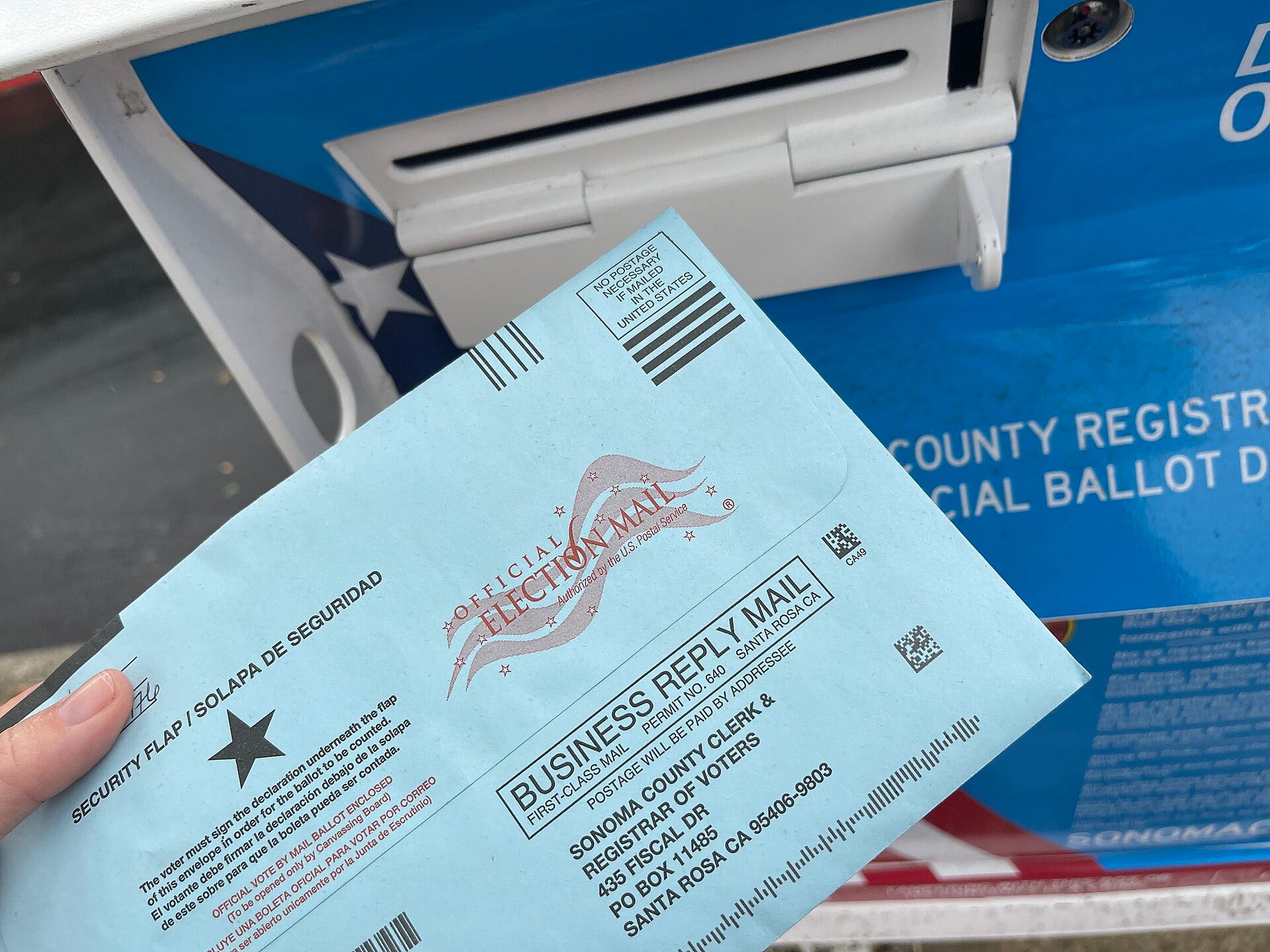

Bear in mind, we are 68 days away from election day, November 3, 2026. USPS wants the rule to be effective now, and—as of this writing—it likely is.1 Two orders that had ordered a pause has since been lifted. Below, I’ll endeavor to make some sense over the dizzying pace of court developments.
On Monday, August 24, 2026, the U.S. Supreme Court lifted a court-ordered pause on the President’s March 2026 executive order and allowed the federal government to implement the executive order and allowed, among other things, the USPS to engage in rulemaking. The Supreme Court’s action stemmed from a case brought by nearly two dozen states and D.C. — including New Jersey. In a 6-3 ruling, the Court concluded that the executive order by itself did not harm the states, thereby depriving the federal courts of the power to intervene. In dissent, Justice Sonia Sotomayor and Justice Elena Kagan disagreed, finding that the states were indeed injured. Justice Ketanji Brown Jackson, in her dissent, warned of the chaos that would follow from the ruling:
States administering elections and the voting public that relies on them to do so deserve clarity, not caginess or confusion. The Court does a disservice to all concerned by distorting Article III standing and ripeness principles to issue a ruling that contributes to pre-election chaos instead of quashing it, and by using its equitable authority to facilitate a patently inequitable result.
Her observations were prescient. The Court made no mention of the final rule that the USPS issued late Friday evening.
On Tuesday, August 25, 2026, U.S. District Court Judge Indira Talwani, who is overseeing a separate suit in Massachusetts by the League of Women Voters, found that USPS improperly worked around her previous injunction by finalizing its rule late Friday evening. Though the judge did not mince words about USPS’s conduct, she declined to grant any further relief because the rule itself prevented its own implementation while the injunction stood.
The next day, on Wednesday, August 26, 2026, Judge Talwani abided by the Supreme Court’s judgment and, in the case brought by the states, lifted the pause over the President’s executive order. Then in regard to the separate and previous order in a lawsuit brought by the League of Women Voters and others directing USPS not to implement the executive order, Judge Talwani reconsidered that order in light of the Supreme Court decision and lifted that order. At bottom, no pauses are left in place to prevent the federal government to implement the executive order.
Also on August 26, two more lawsuits dropped. First, a coalition of 25 states, including New Jersey, challenged the USPS final rule directly. They contend that the rule violates the law in a variety of ways—from a violation of the separation of powers, commandeering state officials to run a federal program, to violations of the Voting Rights Act and the Privacy Act. They are asking for immediate relief to pause the rule. Second, the League of Women Voters, among other organizations, updated their existing lawsuit and brought a direct challenge to the USPS rule. Like the states, the League of Women Voters and its coalition are also asking for an immediate pause of the rule.2
Okay. That’s a lot. Regardless of the outcome, the chaos of the dispute is sowing uncertainty. It erodes confidence with voters who want to vote by mail, and it forces state election officials to prepare for an untold number of contingencies that may never materialize. I’ve already heard of anecdotes from voters believing that because of the government’s efforts, vote-by-mail is completely off the table. And all of this is happening 68 days before the election.
I. Let’s Return to the Executive Order.
It’s worth delving into the source of all this: Executive Order 14399, “Ensuring Citizenship Verification and Integrity in Federal Elections,” which the President signed on March 31, 2026. The President had issued a March 2025 executive order on elections (proof-of-citizenship registration, rejecting mail ballots that arrive after Election Day even if postmarked on time), but that order was largely blocked in court.
The March 2026 executive order has three main aspects. It directs the U.S. Department of Homeland Security, working with the Social Security Administration, to compile state-by-state lists of voting-age citizens from federal databases. It instructs the U.S. Department of Justice to prioritize prosecuting state and local election officials who issue federal ballots to people the federal government deems ineligible. And it directs USPS to build its own list of “approved” mail voters and refuse to deliver ballots to anyone not on it.
The problem with this entire effort is, well, the law. The U.S. Constitution primarily empowers the states and Congress to set the rules for federal elections, not the president. Though the Supreme Court disregarded, for now, the challenge to the executive order due to justiciability concerns (wholly separate from the underlying merits of the executive order), the substance of what the government is aiming to achieve—a massive federal intrusion into the mechanics of state-run elections—faces substantial legal headwinds.
II. New Jersey Pushes Back.
Representing New Jersey, Attorney General Jennifer Davenport joined the multistate coalition suit against the executive order in April 2026. She was direct in her reasons. She called the executive order “a blatantly unlawful executive order that seeks to disenfranchise voters.” Even after Monday’s Supreme Court ruling, she remained focused: “This is a procedural setback, not a final decision on what the Trump Administration is trying to do. The fight continues.”
Under New Jersey law, a vote-by-mail ballot postmarked by Election Day can still be counted if it arrives within six days afterward. Even an unpostmarked ballot counts if it is received within 48 hours of polls closing. But these provisions will be rendered a nullity if the USPS rule is validated. For the voter whose vote-by-mail ballot may fall into this USPS-designed purgatory through no fault of her own, no amount of state-sanctioned grace periods will ever vindicate that voter’s right to be heard through the ballot.
In New Jersey, a voter does not need a reason to vote by mail, and a large portion of the electorate has chosen to do so. “More than 840,000 New Jersey voters cast mail-in ballots in the 2024 general election, accounting for 19.5% of all ballots cast statewide.” In 2025, an off- year election, it was nearly 760,000 vote-by-mail ballots cast.
Just over a month ago, New Jersey stood out as the first in the country to pass post-Callais voting rights reform. The John R. Lewis Voter Empowerment Act, signed by Governor Sherrill on the nation’s 250th birthday, was designed maximize voter participation. The USPS rule appears to be the opposite, imposing unnecessary obstacles for qualified voters to cast their vote.
Not anymore. See footnote #2 below.
UPDATE: Late in the evening on August 27, 2026, Judge Talwani granted the requests by the states and the League of Women Voters coalition for a temporary restraining order. The court found that the challengers would likely succeed on the merits of their claims against the USPS final rule. Judge Talwani also concluded that the states “face irreparable harm where they are required to comply with a likely unconstitutional regulation for which compliance is practically impossible as to the 2026 midterm elections, now little more than two months away.” Moreover, voters “face significant risk of disenfranchisement and interference with their rights under state laws—where they rely on mail-in voting...as permitted under their state laws, but live in a jurisdiction where election officials may not be able to comply with the Final Rule in time for the November 3, 2026 election.”
The USPS final rule is paused under the temporary restraining order for fourteen days. The court will hold a hearing on September 3, 2026, to evaluate whether it will order a longer pause of the USPS final rule for the duration of the litigation and enter a preliminary injunction. If it does, the USPS final rule would be paused through election day.
But count on the federal government to appeal any adverse ruling and pursue an expedited track to SCOTUS.