

Welcome to New Jersey Insight, a periodic newsletter to make law and politics (through a New Jersey lens) more accessible.
These days, no love is lost between the United States and New Jersey. At every turn, New Jersey is either fortifying itself from federal action or deploying a continual volley of legal actions against the United States.
Under the first Trump Administration, the disputes that occurred then feel quaint—yet still serious—by comparison. For example, over six years ago when I served in state government, I remember working late at my desk when we learned that the United States brought a legal challenge against New Jersey. With a caption that would trigger a bout of anxiety for any state government lawyer (United States of America v. State of New Jersey), the lawsuit centered on the state’s policy that drew clear lines between the roles of state and local law enforcement officers and federal civil immigration agents.1 We successfully persuaded the court to dismiss the lawsuit, by the way.
More disputes mounted back then, some of which involved the rescission of the Deferred Action for Childhood Arrivals (DACA) program, the limitation of the state and local tax deduction, the family separation policy at the border, net neutrality, and the citizenship question on the 2020 Census.
Today, the strife between New Jersey and the federal government feels even more harsh, and no other area exemplifies this than immigration. The conflict over immigration-related policies has had a cascading effect across the state, ranging from incredibly low approval ratings among New Jersey voters for the President (coupled with the wide backlash from elected officials) to communities banding together to support their neighbors in the face of an overzealous immigration enforcement apparatus.
In this post, I’ll highlight the significant (and at times dizzying) array of immigration-related developments in New Jersey—which has the second highest percentage of immigrants in the U.S. I’ll also offer a perspective of what this all might mean in the short to medium term.
Legislative Actions
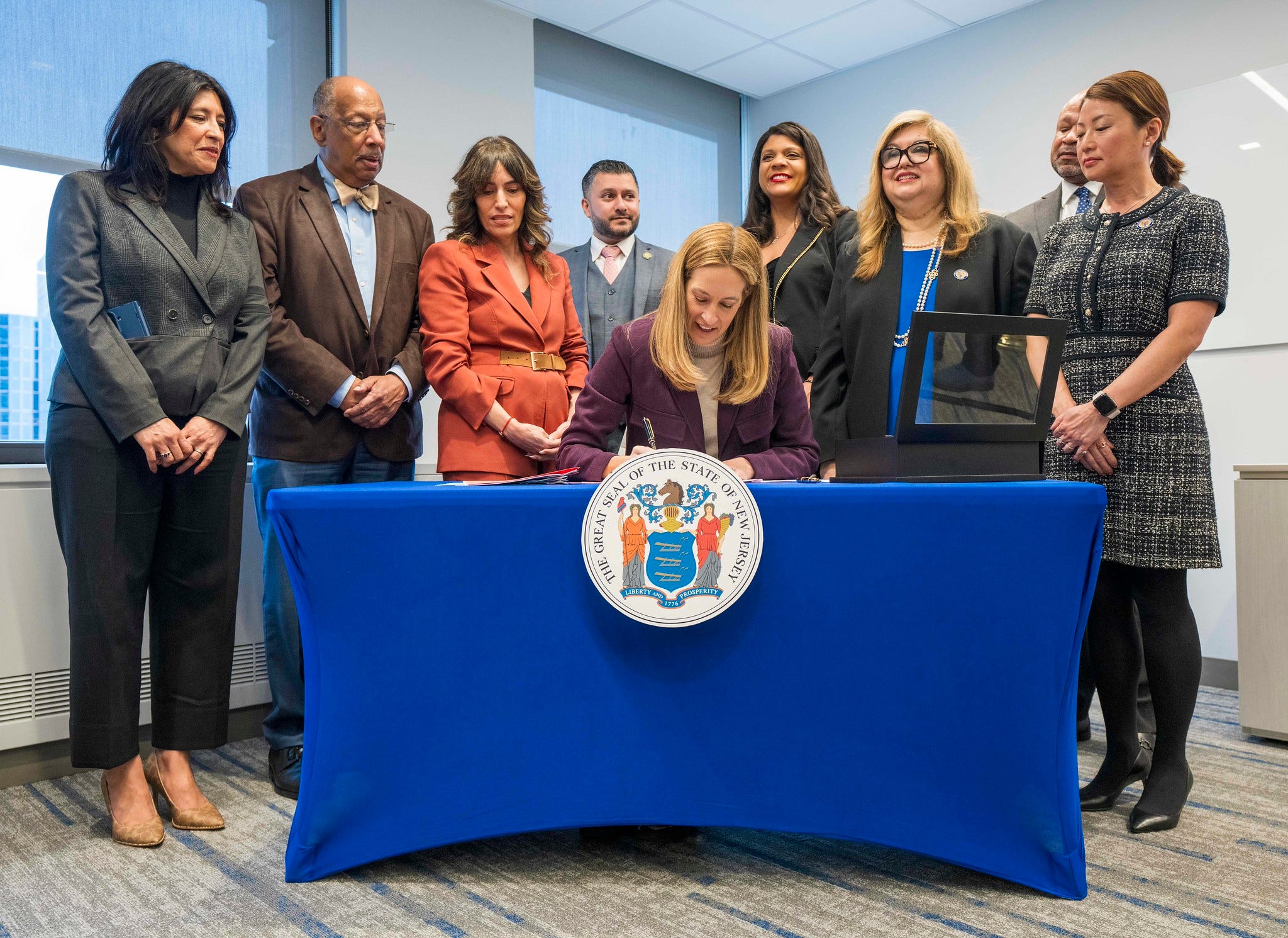
Law making is messy, but the New Jersey Legislature is on record objecting to the immigration policies of the federal government. It passed—and Governor Mikie Sherrill approved—three bills designed to maintain distance between the state and federal immigration enforcement and counteract some of the most egregious behaviors from federal officers.
The first bill codifies into law the Immigrant Trust Directive, a policy that limits the interactions between state and local law enforcement personnel and federal civil immigration enforcement authorities. As I’ve explained before, the legislation “delineates lines of accountability and a policy judgment by elected officials on the best use of law enforcement resources.” Since the federal government has near exclusive authority over immigration, New Jersey can reasonably decide to leave that realm to the federal government, avoid the entanglement, and focus instead on proven public safety measures, like building trust with its residents. The codification of the Directive—which is an executive policy issued by the New Jersey Attorney General—will now have a degree of permanence in the state.
The second bill addresses the routine practice by U.S. Immigration and Customs Enforcement (ICE) agents wearing face coverings during enforcement operations. Though not exclusively targeting federal law enforcement, the newly-enacted bill prohibits mask-wearing for any law enforcement officer (local, state, or federal) in New Jersey “while in the performance of the officer’s official duties” and requires them “to provide sufficient identification prior to arresting or detaining an individual.” Though support for the bill fell largely on party lines, one prominent and well-respected Republican lawmaker, State Senator Jon Bramnick, supported the bill and acknowledged that “law enforcement faces risks, but they do not hide behind a mask.” He elaborated:
When officers engage with individuals and communities, the public has a right to know who is exercising governmental authority. Requiring visible identification helps ensure accountability, reduces confusion and fear, and protects both officers and the public.
I agree. In a democracy, the people have a right to hold the actions of their government to account, whether through the ballot box, peaceful protest, or legal action. To do so, identifying the government actor, especially law enforcement agents who are empowered to use physical force when necessary, is fundamental to democratic accountability.
Lastly, the third bill, which is entitled the “Privacy Protection Act,” limits governmental and health care entities from collecting or sharing certain information like a person’s immigration status. Proponents of the bill sought to alleviate the fear that some may have in accessing necessary services. The bill’s sponsors made no secret that the actions of the federal government animated their concern:
“Across the country, the hostile climate this administration has created for immigrants and their families is making individuals hesitant to access essential services, regardless of their legal status,” said Senate Majority Leader [M. Teresa Ruiz]. “No one should be afraid to seek health care or public services because of the personal information they are asked to provide. The ‘Privacy Protection Act’ limits the collection of private information when it is unnecessary to receive services and ensures confidentiality so all New Jerseyans can access the support they need without fear.”
“Protecting people’s personal information is fundamental to maintaining trust in government and ensuring access to necessary services,” said Senator [Andrew Zwicker]. “As federal authorities use government records for their aggressive and mean-spirited immigration enforcement, New Jersey must strengthen our privacy protections to prevent harm.”
Thus, with these three bills now law, New Jersey sends the message that (1) it has no desire to entangle itself with the federal government’s civil immigration enforcement practices; (2) accountability and trust are pivotal for the relationship between the government and the people; and (3) critical services ought to be accessible to all state residents, regardless of their immigration status.
Another bill, which currently remains pending, would go even further in the accountability spectrum. Borrowing a page from my previous note about state-sanctioned mechanisms to hold federal officers accountable, two state lawmakers—Assemblymembers Ravi Bhalla and Katie Brennan—introduced legislation, with unmistakable Jersey attitude, called the “Fight Unlawful Conduct and Keep Individuals and Communities Empowered Act.”2 The bill would create a state cause of action against ICE agents to hold them accountable for federal constitutional violations.3 So far, no movement on the bill, but it’s something to monitor.
Executive Actions
Today, both Governor Sherrill and the Legislature are in lockstep in their shared, profound disagreement with the immigration enforcement policies of the federal government. For Governor Sherrill, though, this was not always the case. As a candidate for office in 2025, and considering the results of the 2024 elections, she had been much more cautious on the topic, declining, for example, to answer questions about immigrant protections. But now, the Governor has abandoned such measured tones with a clarity that minces no words over the conduct of the federal government. She has compared, for instance, the recent conduct of ICE “to the secret police of East Germany” and called it “Trump’s personal militia.”
Beyond legislation and rhetoric, Governor Sherrill has oriented her administration to combat the excesses of federal immigration enforcement. In the aftermath of the federal government’s horrific conduct in Minneapolis and the deaths of Renée Good and Alex Pretti, she set up an online portal for New Jersey residents to submit reports of interactions with ICE and allow the state to “hold ICE accountable for their actions, including potential violations of the law.” To that end, New Jersey Attorney General Jennifer Davenport expressed her willingness, if the circumstances warrant, to pursue criminal charges against federal officers that violate state law.
Through an executive order, Governor Sherrill has also prohibited ICE agents engaged in federal civil immigration enforcement from “entering, accessing, or using nonpublic areas of State property for their operations unless authorized by a judicial warrant.” In response, the U.S. Department of Justice challenged the Governor’s policy in federal court, arguing that the Governor’s actions obstructs enforcement of federal immigration law.
The case remains in its early stages, but I’m generally skeptical of the federal government’s argument. It’s one thing for the state, as a regulator, to impose direct impediments to the functions of the federal government. But it’s another thing entirely when the state, as a property owner, chooses not to permit certain activities—like the staging for federal civil immigration enforcement operations—to occur in the nonpublic spaces of its own property. The state isn’t getting in the way of federal operations; it’s just that the federal government will have to carry out its operations without the use of the state’s nonpublic property. It’s as if your local police department asked you if their officers could hang out in your home for a few hours in preparation for executing a search warrant for your neighbor’s house across the street. As the property owner, you would be well within your rights to deny their request. New Jersey is effectively doing the same and would rather, as mentioned above, separate itself from federal civil immigration enforcement operations, a legitimate policy goal.4
Legal Actions
Unsurprisingly, the courts across the country have played a central role in the immigration enforcement debates. It’s no different in New Jersey. In addition to the lawsuit challenging Governor Sherrill’s executive order limiting access to state property, the DOJ is also challenging the policies of four cities in the state—Newark, Jersey City, Paterson, and Hoboken—that align with the state’s Immigrant Trust Directive.5
Conversely, federal judges in New Jersey are increasingly raising the alarm over the conduct of the federal government, whether it be impatience with the number of illegal detentions or DOJ’s own acknowledgement that it violated more than 50 court orders in New Jersey alone.
On top of these disputes are criminal actions against two elected officials. As a result of an incident last year outside of Delaney Hall, a privately-run immigration detention center in Newark, the mayor—Ras Baraka—was arrested on a trespassing charge. Though federal prosecutors ultimately dropped the charge, the U.S. Magistrate Judge harshly reprimanded federal prosecutors for even pursuing the criminal case at all, calling the decision to drop the charge an “embarrassing retraction.” From the same scuffle, a grand jury indicted Congresswoman LaMonica McIver for, among other things, allegedly assaulting a federal officer. That criminal case remains pending.
Local Actions
Local communities in New Jersey are not immune to the push and pull of the immigration enforcement debates. School districts across the state have raised fears of immigration enforcement operations in and around their schools. One enforcement operation in proximity of a school in the southern part of the state resulted in fear ricocheting across that community. The state Department of Education has provided guidance to school districts on how to address ICE agents at schools.
I mentioned Delaney Hall above, which had reopened in 2025 and could hold over 1,000 individuals in immigration detention. The backstory behind Mayor Baraka’s arrest that day involved his interest as the chief executive of Newark. He was raising concerns over the lack of inspection at Delaney Hall and other permitting and safety issues, areas that are usually overseen by local governments like Newark.
Even zoning issues are not spared. The U.S. Department of Homeland Security purchased a huge warehouse in Roxbury. Instead of warehousing Amazon packages (consistent with its intended use), the federal government wants to use it to warehouse people instead (not an intended use, to be clear) for immigration detention. In a bipartisan response, both the municipality and the state brought suit challenging the purchase.
So what does this all mean? A few things.
For one, the Trump Administration remains focused, albeit with some modest course corrections, on maintaining its aggressive immigration posture targeting those with and without criminal backgrounds. Second, opponents like New Jersey are using every lever at their disposal to curb the excesses of the federal government’s actions. Evidenced by the large margin of victory that catapulted Governor Sherrill into office, her administration is channeling the frustrations of New Jersey voters through action and imposing some degree of accountability.
Lastly, every action and reaction represent the push and pull on the immigration pendulum. During the Biden Administration, some would say that the pendulum swung too far to one end, representing a lax immigration enforcement apparatus. Now, others would say the pendulum shifted way too far to the opposite end, resulting in an overly harsh immigration enforcement paradigm. I have my views (which you likely gathered in my writings), but the views of the American electorate will count more.
If the developments in New Jersey are any indicator, I suspect that a push on the immigration pendulum may happen this November. And those results may set the stage for a correction in the next few years, with an eye toward—I hope—an equilibrium where immigration enforcement policy rests on constitutional limits, the rule of law, and the dignity of every person.
The policy, which is called the Immigrant Trust Directive, is one that I helped advance with a great team during my time at the New Jersey Attorney General’s Office. More on this topic below.
I’ll let you decipher the acronym for the bill.
In my view, the New Jersey Civil Rights Act, a current law which likely permits civil lawsuits against federal officers to vindicate an individual’s constitutional rights, may be the preferred vehicle. While I’m certainly receptive to strengthening and clarifying existing law, I am doubtful on whether a new state cause of action, like the one envisioned in this bill that specifically targets federal officers, can pass legal muster. Ordinarily, a state cannot act in a way that outright discriminates against the federal government. But if a state law, for example, has general application over a subject matter, does not discriminate against or regulate the federal government, and happens to also incidentally impact federal employees, such a law has a better chance of surviving a legal challenge. The NJCRA, I believe, is such a law since its objective is to discourage unconstitutional conduct across the board by any individual acting under color of state or federal law. In other words, it does no more than what the constitution requires: faithful adherence to the Nation’s charter.
The federal government also argued that New Jersey engaged in differential treatment because it “treats local and state law enforcement more favorably by providing unrestricted access to state-owned property.” The comparison, however, is inapt. Judge Freda Wolfson recognized over five years ago in her decision rejecting DOJ’s challenge to the Immigrant Trust Directive that the appropriate comparator to civil ICE operations isn’t local and state law enforcement generally, but civil law enforcement agencies. Notably, she concluded that “civil immigration operations and criminal law enforcement are not similarly situated.”
This lawsuit mostly rehashes the arguments made in the DOJ’s last lawsuit under the first Trump Administration when it unsuccessfully challenged the Immigrant Trust Directive. As the cities have pointed out, the DOJ’s lawsuit against them is simply a poor attempt to relitigate its prior loss on the same topic.
Lol at "with unmistakable Jersey attitude"