

Welcome to New Jersey Insight, a periodic newsletter to make law and politics (through a New Jersey lens) more accessible.
The memory of the attacks that occurred twenty-five years ago today has been permanently etched in my mind, as I suspect is the case for most of my generation. Now, just like the pandemic, we speak about life before September 11, 2001, and after September 11, 2001—that however confident we felt about American life before, the attacks of Sept. 11 shattered such confidence, leaving the population in a state of shock and with a collective psychology that acutely focused on threats, whether real or perceived, of those who sought to do harm.
Per one report, over “100 million people in the United States today were not alive” on Sept. 11. Thus, for this issue, I wish to reflect on the attacks of Sept. 11 from a personal and national lens, and what it meant for New Jersey, which suffered the second highest number of casualties that day behind New York.
I.
On the morning of Sept. 11, I was not home on the east coast, but instead across the Atlantic Ocean over 3,600 miles away in London, England. In fact, I arrived in London on September 10, 2001, as a young college student to start my fall semester studying abroad.
This was my first time living overseas without any family or friends nearby. Feelings of homesickness quickly arrived, but the events of Sept. 11 compounded those feelings more.
That morning, I began the day with an orientation with my fellow study abroad cohort. We were all excited and looking forward to spending three months in London on our own. We received a briefing on what to expect during the semester and a crash course on life in London. That afternoon after lunch, we boarded a bus to tour all of the major sites in the city. Not too long after we departed, the bus operator made a rather matter-of-fact announcement to his group of young American bus passengers: according to initial reports from the BBC, a small plane crashed into the World Trade Center in New York City. Details were fuzzy, per the bus operator, but that’s all he knew. Not knowing anything more, we proceeded with our bus tour.
But then, the bus drove us to visit The American School in London, where the staff was noticeably quiet and somber. They quickly directed us to an all-purpose room with a giant television screen. The head of our study abroad program entered the room with what seemed to be the weight of the world on his shoulders. Holding back tears, he shared the details and gravity of the Sept. 11 attacks. He then activated the large television screen, where we immediately saw the early images of the destruction in New York City and the Pentagon.
Shock descended upon all of us. Some of my fellow students gasped; they had family and friends in New York City—as did I. One student cried all night in her room because she could not get a hold of her family who was likely in the vicinity of the World Trade Center that morning. All phone lines to the United States were down. All flights to the U.S. were canceled.
I finally spoke with my family a day later, and thankfully, they were all safe. But at the moment, with all contact severed with the U.S., the feelings of loneliness and isolation were sharp. As the days passed, I even explored whether I should abandon the study abroad program and return home.
Thinking back, I’m glad that I didn’t, despite the instinct to run home. The experience of living overseas and fending for myself at that young age developed a sense of confidence in myself that I did not have before. Even in the aftermath of the horrific attacks and the devastating loss of life, we learn to endure.
But no question. Our lives after Sept. 11 would be different. We had to come to terms with an act of war that sought the destruction of the World Trade Center and the Nation’s capital. We hadn’t seen such an attack since Pearl Harbor in 1941, and here, the attacks were designed to maximize casualties on military and civilian targets. It took a toll on the national consciousness, and it manifested in a variety of ways.
First, folks saw the impact whenever they traveled. An overhaul in airport security initially involved the deployment of fully armed service members of the National Guard at airports across the country, followed by uniformed agents from the newly formed Transportation Security Administration. Intense screening of airline travelers would be the norm, including—for me—being selected frequently (and what felt like disproportionately) for more in-depth security screenings. Congress also mandated stricter identification requirements, like the REAL ID Act.
Second, we witnessed the sharp rise in hateful acts against Muslims, Sikhs, those of Arab and South Asian descent, and anyone perceived to be such. Hateful comments seemed commonplace, and any outward indication of one’s Islamic faith was verboten. Though President George W. Bush spoke of Islam in inclusive terms, his words did not dampen the presence of hate in American life, which, unfortunately, has remained with us—if anything, more so—today.
Third, the federal government acted with laser focus to prevent such an attack again. The federal government completely reorganized its law enforcement apparatus, consolidating, for example, law enforcement resources through the formation of the Department of Homeland Security and crafting a better intelligence-sharing operation through the new Office of the Director of National Intelligence. And of course, seven days after Sept. 11, Congress authorized the use of military force, which resulted in military conflicts in Afghanistan, among other places.
At bottom, the country—both inward and outward—reoriented itself to root out any risk to its physical security. That reorientation remains with us today. But, I’m disappointed to say, one of the byproducts of those times, the increased scourge of hate, has stayed with us as well.
II.
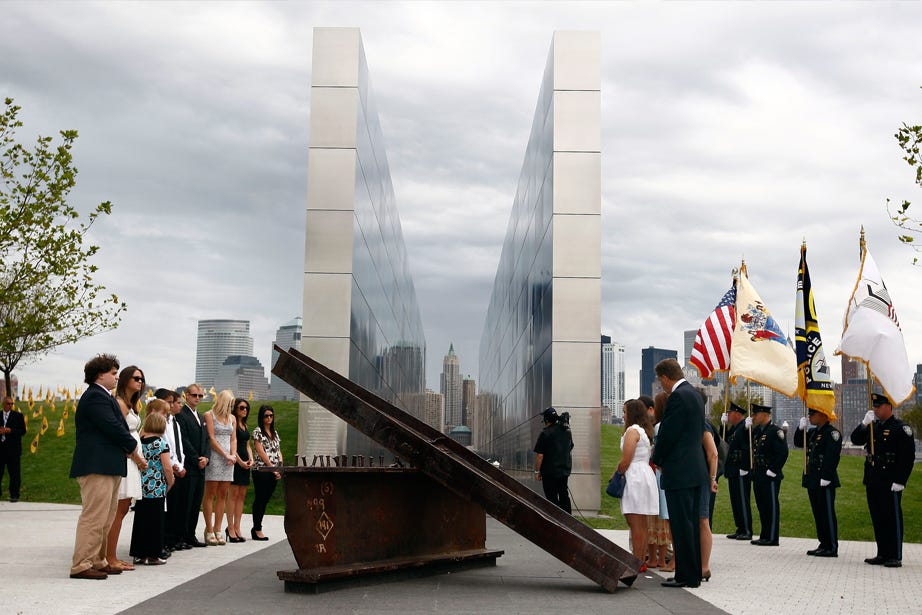
The people of New Jersey felt the tragedy deeply. Over 700 New Jersey residents died that day. Out of the state’s 21 counties, all but three saw at least one resident die from the tragedy. In 2001, Sept. 11 was the second leading cause of death in New Jersey for those between the ages of 25 and 44. The impacts on neighborhoods and communities across the state simply cannot be overstated. The loss was immensely personal to New Jerseyans. It was irrevocable.
In turn, New Jersey leaders acted swiftly to fortify the state. Beyond the immediate emergency measures, such as the mobilization of the New Jersey National Guard to key infrastructure and the delivery of relief to the families of the victims, the state overhauled its security posture. Weeks after Sept. 11, the state legislature enacted the Domestic Security Preparedness Act, which created, among other things, the New Jersey Domestic Security Preparedness Task Force. Chaired by the Attorney General, the Task Force oversaw “all activities related to domestic preparedness for a terrorist attack.” It was considered “the most extensive and coordinated interagency operation in the history of the executive branch of New Jersey state government.”
Soon, however, the need arose to operationalize the work of the Task Force. In January 2002, a new governor, Jim McGreevey, assumed office, and nine days later, he created the Office of Counter-Terrorism to identify, deter, and detect “terrorist-related activities.” Over the years, it evolved into what is now the Office of Homeland Security and Preparedness, which is charged with not only counterterrorism, but also counterintelligence, cybersecurity, and preparedness at all levels of government. In the years after Sept. 11, New Jersey also established the Regional Operations Intelligence Center, otherwise known as a “fusion center,” which acts as a 24/7 intelligence hub for all levels of law enforcement.
The reforms installed post-Sept. 11 proved to be critical in the coming decades. For example, the months after Sept. 11 saw a series of anthrax mailings, “in what became the worst biological attacks in U.S. history.” This included a significant contamination event at a major postal center in Hamilton, New Jersey, which—with Sept. 11 as the backdrop—revealed the vulnerabilities of an effective government response to such biological threats. The U.S. Centers for Disease Control and Prevention led the effort to develop model legislation for states to adopt emergency health powers. New Jersey used the model to develop its own legislation called the New Jersey Emergency Health Powers Act (EHPA). Enacted in September 2005, it empowers the executive branch—in the face of a declared public health emergency—with sweeping legal and surveillance authority to combat contagious diseases and mandate vaccinations.
The EHPA stayed dormant on the books for fifteen years until March 2020. To combat the rapid spread of COVID-19, Governor Murphy invoked the EHPA in Executive Order No. 103 and declared a public health emergency, the first such declaration in New Jersey’s history.
Twenty-five years later, the lessons and the aftermath of Sept. 11 remain embedded in our collective subconscious and our institutions. In the short term, it upended countless lives. Over the long term, it fundamentally changed not only how government acts and responds, but also how it views its role as a guarantor of security. The lasting changes in New Jersey are a case in point.
I’ll leave you with one reflection from my early years in practice. I started my career as an attorney at the New Jersey Attorney General’s Office about six years after Sept. 11. Even though years had passed, I was struck by the office’s deep ethos about its role in the recovery after Sept. 11. This included the scores of attorneys from my office who volunteered their time to assist families in the heartbreaking task of filing for death certificates and, in an even more heartbreaking task, filing for judicial declarations of death when the remains of their loved ones were missing. The experience deeply shaped our culture of public service and professionalism.
I realize that, for many today, Sept. 11 feels distant, and reflections like mine may not resonate. But the theme ought to feel familiar. Sept. 11 showed the worst in some to exact hate and destruction. It prompted the country to revisit its place in the world. But it also showed our collective capacity to overcome. That we can actually come together, despite our profound differences, to address the challenges of our day in common cause. Especially in these times, it should be a reminder that we can do so again.