

Welcome to New Jersey Insight, a periodic newsletter to make law and politics (through a New Jersey lens) more accessible.
A few weeks ago, on behalf of a broad coalition of bar associations from across the country, my stellar legal team and I filed an amicus brief with the U.S. Supreme Court defending birthright citizenship. You can read more about that advocacy here, and you can read the coalition’s brief here.
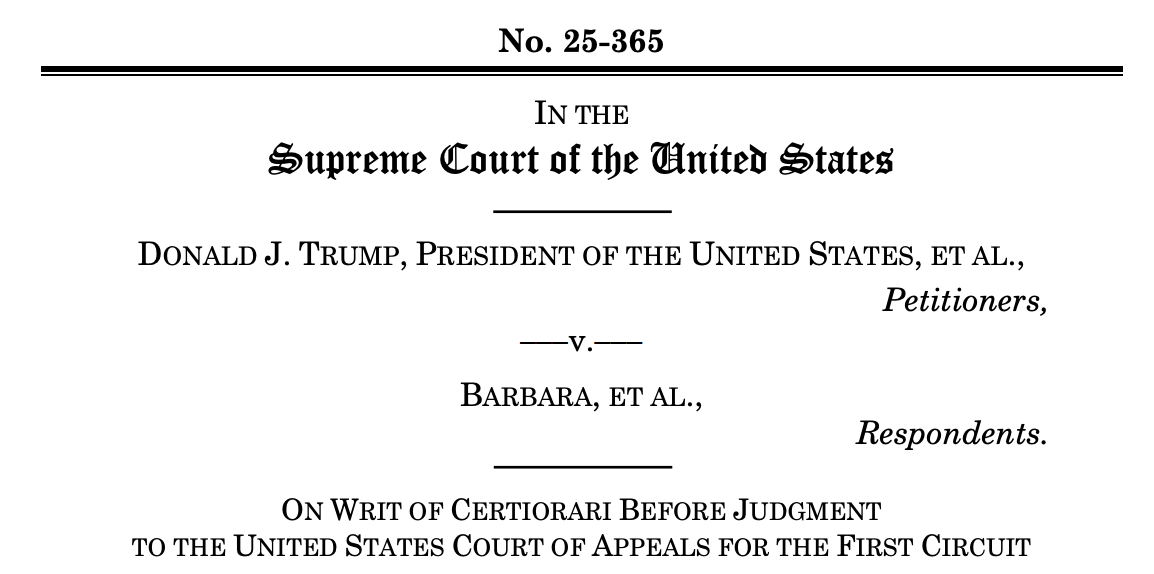
Today, I want to focus on not only how we arrived at the footsteps of the Supreme Court, but also explore the consequences if the Court allows the federal government (for the first time in nearly 130 years) to limit which babies born on American soil can acquire citizenship. The demographic profile of New Jersey provides a stark example of those consequences. Bottom line: They would be profound.
The Early Campaign to Limit Birthright Citizenship.
To understand the current controversy, we should start at the beginning. About 160 years ago, the Nation had just fought a bloody civil war, and a whole population of formerly enslaved persons were entering an era where the country, through the passage and ratification of the Thirteenth Amendment, discarded the horrific institution of slavery. Yet despite this new dawn and a period of reconstruction, Dred Scott v. Sandford, 60 U.S. 393 (1857), remained the law of the land. In Dred Scott, the U.S. Supreme Court held that a Black person, whether enslaved, formerly enslaved, or never enslaved, could not be an American citizen - ever.
President Abraham Lincoln rejected the notion. And so did Congress. After the Civil War ended, it passed the the Civil Rights Act of 1866, which declared that “all persons born in the United States and not subject to any foreign power, excluding Indians not taxed, are hereby declared to be citizens of the United States.”
Though Congress passed a law, a risk remained that the law could be struck down as unconstitutional under Dred Scott or, alternatively, that a future Congress would change the law. Congress, and the Nation, ultimately adopted the Fourteenth Amendment in 1868. The operative portion of the Citizenship Clause of the Fourteenth Amendment is pithy and plain: “All persons born...in the United States, and subject to the jurisdiction thereof, are citizens of the United States.”
During Congressional debates, members of Congress argued whether the Amendment would reach beyond the formerly enslaved and their children, and apply to others. The debates illustrated an understanding that the Amendment would in fact apply to those other categories such as Chinese migrants and “gypsies,” groups that were heavily despised. One senator remarked, in response to a question on the Amendment’s applicability to the children of Chinese migrants, that the Amendment would “incorporate…in the fundamental instrument of the nation…that the children of all parentage whatever, born in California, should be regarded and treated as citizens of the United States, entitled to equal civil rights with other citizens of the United States.” Another senator seemingly understood this broad application as well. In response to an inquiry on whether the children of parents from another country temporarily present in the United States would receive the benefit of citizenship (with the exception of children of foreign ministers), the senator answered yes.
Years later, anti-Chinese sentiment reached new heights across the Nation. Congress passed discriminatory laws like the Page Act of 1875 and the Chinese Exclusion Act of 1882— policies that etched anti-Chinese sentiment into restrictive and discriminatory immigration laws. But on the question of the outer limits of birthright citizenship, and to further expand the Chinese Exclusion Act, the United States government searched for a test case to settle the notion that the children of Chinese migrants (or in the vernacular at the time, “subjects of the Emperor of China”) could ever become part of the fabric of American life.
Ultimately, federal officials found their mark with Wong Kim Ark. Born in San Francisco in 1873 to Chinese immigrant parents, Wong sought to return to the United States after a visit to China in 1895. The government denied Wong reentry under the Chinese Exclusion Act, arguing that Wong was not an American citizen because he was born to parents who were Chinese nationals. Wong brought a challenge to his detention in federal court, and ultimately, his matter reached the U.S. Supreme Court. In United States v. Wong Kim Ark, 169 U.S. 649 (1898), the Court sided in Wong and rejected the government’s position. It emphatically affirmed citizenship by birth and declared that the government cannot exclude “Chinese persons born in this country from the operation of the broad and clear words of the Constitution.”
Thus, for more than a century under Wong Kim Ark, the rule of birthright citizenship prevailed, and Congress reaffirmed this understanding over the decades. Babies born in the United States, regardless of the circumstances of their parents,1 were citizens of the United States. Period.
Now fast forward to the contemporary age of politics, where settled rights feel no longer settled.
The Modern Campaign to Limit Birthright Citizenship.
The controversy over the modern attacks on birthright citizenship started in earnest not in 2025 when President Donald Trump assumed office, but more than fifteen years ago. Immigration policy featured prominently in political discourse then (as it does now), including the treatment of undocumented individuals.
U.S. Senators David Vitter (LA) and Rand Paul (KY) introduced legislation entitled the Birthright Citizenship Act of 2011. Under the bill, a baby would only receive American citizenship if at least one of the baby’s parents was a citizen, a green card holder, or an individual in active service with the armed forces. On top of this effort in Congress, some state lawmakers, such as in Arizona and elsewhere, introduced similar legislation in state legislatures. They designed these efforts to essentially prompt Supreme Court review. Subsequent efforts at the state and federal level continued over the years.
Ultimately, the rumblings around birthright citizenship reached a receptive audience at the White House. In 2018, during his first term, President Trump wanted to restrict birthright citizenship, but he did not act on it. During his presidential campaign for a second term, President Trump promised in 2023 that if he returned to office, he would “end automatic citizenship for children born in the United States to immigrants in the country illegally.”
After assuming office again, he finally kept his promise. On his first day of his second term, January 20, 2025, the President issued Executive Order 14160 and directed federal agencies to only recognize citizenship (on a prospective basis) for those babies born to either American citizens or green card holders. No one else. Hours later, litigation ensued. Not long after, federal courts across the country imposed nationwide pauses on EO 14160, with one federal judge in Seattle remarking that in his four decades-long judicial service, he couldn’t remember “another case where the question presented is as clear as this one is,” asking “Where were the lawyers?” The judge called the EO “blatantly unconstitutional.”
With the losses racking up, the federal government, represented by the Solicitor General of the United States, sought review from the Supreme Court. In a creative (and ultimately successful) move, the government asked the Court not to address the underlying merits of the cases (i.e., whether EO 14160 was lawful), but instead focus on a procedural question that had long bothered presidents from both parties and justices on the Court outside of this case: whether lower federal courts have the authority to impose nationwide (or in the Court’s vernacular, universal) injunctions that had the effect of pausing federal government policy not just for the parties bringing the lawsuit, but for everyone.
The Court accepted the gambit. On June 27, 2025, in a 6-3 decision captioned Trump v. CASA, Inc., 606 U.S. 831 (2025), and authored by Justice Amy Coney Barrett, the Court agreed with the government and ruled that universal injunctions are no longer a remedy that federal courts could impose. Instead, Justice Barrett concluded that federal courts could only craft injunctions that were no “broader than necessary to provide complete relief to each plaintiff with standing to sue.” The Court did not address the lawfulness of EO 14160 and returned the cases to the lower courts for yet more proceedings.
The losses for the federal government continued. Court after court concluded that EO 14160 violated the Constitution and federal law. And even under the CASA rubric, courts delivered far-ranging relief to pause EO 14160, whether because nearly half of the states brought the legal challenge (and thereby benefiting the residents of those states and beyond) or because expectant parents brought class actions necessitating class-wide relief for any baby impacted by EO 14160.
To abide by a promise made to the Supreme Court, the Solicitor General asked the Court to review the matter on the merits and finally decide the lawfulness of EO 14160. The Court agreed. It set oral argument for April 1, 2026, with a ruling expected by the end of June.
New Jersey Would Bear the Brunt of EO 14160.
I’m cautiously optimistic that an unbroken line of judicial precedent, history, Executive Branch practice, and Congressional practice will lead to the inevitable demise of EO 14160. But it is worth pausing to understand the implications if the executive order is upheld. In a state like New Jersey, the effects would be felt deeply.
The most densely populated state in the country, New Jersey is home to 9.5 million people with ancestors that cover nearly every corner of the globe.
A large share of the state’s population consists of immigrants, nearly 25% (about 2.4 million).
Of the immigrant population, 44% (just under 1 million) are noncitizens.
And of those noncitizens, more than half (nearly 530,000) are undocumented, making up under 6% of the total state population.
About 23,000 international students attend colleges and universities in New Jersey.
One estimate shows that approximately 6,200 children are born annually in New Jersey to two undocumented parents, an estimate that is likely an undercount.
Over the last three years, the number of births per year to an undocumented mother where certain costs were covered by Medicare was between 7,000 and 8,000.
Over 150,000 children who are considered citizens today reside with at least one undocumented parent.
The refugee population in New Jersey is estimated at 48,500.
The number of individuals holding temporary protected status (TPS) is over 26,000.
The number of highly skilled workers who are in New Jersey on a H1-B visa is over 20,000.
At bottom, if EO 14160 went into effect, the lives of a large portion of New Jersey residents would be unsettled. From international students, international workers, and the undocumented to refugees and TPS holders, thousands upon thousands in New Jersey alone would have to order their lives and prepare for the possibility that if they have a child, that child would be denied the ability to establish roots in the only country that they know.2
If the United States withholds citizenship from those children, it is entirely unclear whether those children would be a citizen of any country. Parents would have to research whether their country of origin would confer citizenship on a baby born in the United States. What happens if the parents are each from different countries of origin? In a diverse state like New Jersey, the scenarios are nearly limitless and inevitable. When the child is born, is that child immediately removable from the United States? If so, to what country? The confusion, heartbreak, and frustration would be pervasive throughout.
And though EO 14160 is designed to be prospective and apply to future babies, it would give little comfort to those born today in circumstances contemplated to be excluded under the EO. The policy opens the door for others to question their citizenship, and the federal government offers no guarantee that the policy would remain prospective. Its choice to do so appears to be a matter of administrative convenience. If the federal government prevails on the merits of their position, what would stop it from applying it retroactively?
Despite these nightmare scenarios, and despite the campaign to limit birthright citizenship over the many years, I am hopeful that good judgment will prevail. The overwhelming reliance of generations who were assured that their children born in the United States would be citizens of the United States should not be simply stripped away. The Thirteenth and Fourteenth Amendments, when working together, sought to eliminate caste and class in the law - building on the very notion of liberty guaranteed to every American, not the creation of an underclass.
The Citizenship Clause promises an equal claim to citizenship for future generations. It is a critical part of what Dr. Martin Luther King, Jr., coined the “inescapable network of mutuality, tied in a single garment of destiny.” The federal government fails to demonstrate any good reason3 to abandon that promise today.
The Supreme Court, I hope, ought to agree.
At the time, the Supreme Court recognized a few narrow exceptions to the general rule. The children of foreign sovereigns (including diplomats), enemies in a hostile occupation, and tribal members. And regarding the latter, Congress later passed a law to confer citizenship for Native Americans.
I remember that when my daughter was first born during the height of the pandemic, my wife and I had countless worries as new parents. Whether our child would be a citizen of the United States was never one of them, and I cannot imagine the calculus if we had been in such a scenario.
Some of the reasons that the federal government advanced, like the purported incentive for individuals to arrive in the U.S. for the sole purpose of acquiring citizenship for their children (i.e., birth tourism), is grounded more in policy preferences rather than constitutional law. If the government truly wanted to address birth tourism, it has plenty of executive and legislative tools at its disposal.