

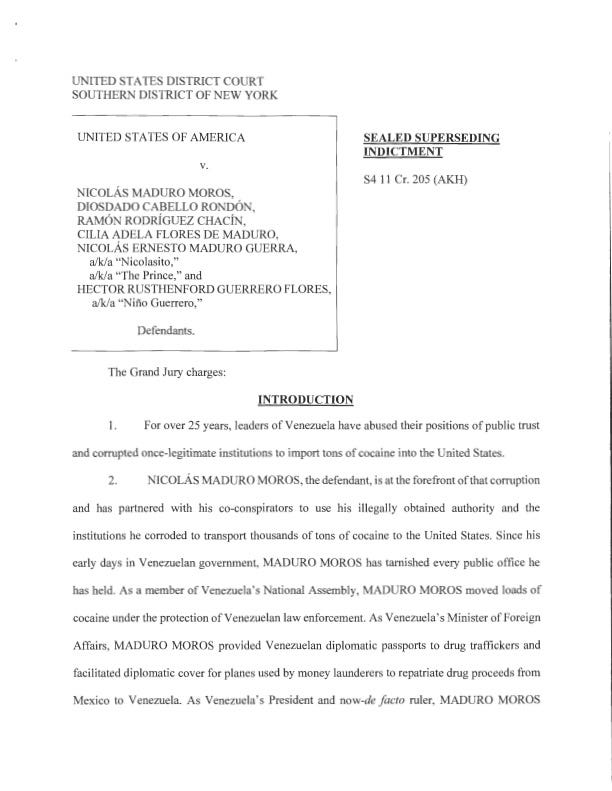
Mere days into 2026, and in the final moments of the holiday season, we woke up on Saturday morning to the news of a brazen U.S. military operation in Venezuela. United States personnel captured Nicolás Maduro, the disputed leader of Venezuela, and, by Saturday evening, transported him to the federal detention center in Brooklyn to face a superseding, four-count federal indictment involving, among other things, terrorism and narcotics charges.
Make no mistake. Maduro doesn’t exactly elicit any sympathy. Though he assumed the presidency of Venezuela in 2013, after the 2018 presidential election, the national Venezuelan legislature refused to recognize Maduro as the legitimate president. The United States has not recognized Maduro as Venezuela’s leader since 2019.
A federal grand jury in the Southern District of New York originally returned a criminal indictment in 2020 and charged Maduro with, among other things, narcotics trafficking, terrorism, and the possession of destructive devices.
After the 2024 presidential election, Maduro declared himself the leader despite evidence to the contrary. In the end, his hold on the Venezuelan presidency barely had the veneer (if at all) of any democratic legitimacy - on top of the troubling accusations of narcotics trafficking.
So yes, now that Maduro is detained in the United States, he ought to face trial for the serious charges leveled against him. And as with any criminal defendant in the U.S., Maduro will (and should) have the full panoply of protections under American law so that he can defend himself.
But no matter how just the ends are, they do not (and cannot) justify the means. The means themselves must be defensible. I can understand the compulsion of an executive to seek results swiftly without being bogged down with process (the “means”). Though not the best comparison, our current political discourse is heavily focused on affordability and how leaders can quickly act and cut through red tape to secure relief, whether it be on housing, wages, or the cost of living. A whole book makes the case that in areas like building homes and infrastructure, leaders should focus more on results and less on burdensome process.
But this isn’t the building of a house or a bridge. When it comes to war and peace, the means matters. In fact, it’s the means that can actually avoid war and keep the peace.
And here, the means is defined by law. One doesn’t need to be a legal expert to conclude that - at a minimum - absent a threat to the security of the United States, an authorization from Congress, or a blessing from the United Nations Security Council, this military action was “entirely unauthorized by U.S. law” and “a textbook violation of international law.”1
Now, the country, and the people of Venezuela, are left with the consequences. A thought has been playing repeatedly in my mind today since the news broke. An old adage tells us that history can repeat itself unless we learn from it. But rather than repeat, I believe history tends to rhyme. Last night’s military action evokes memories of U.S. intervention in so many countries in the Western Hemisphere, such as in Nicaragua, Panama, Cuba, Chile, El Salvador, and others - a long line of history that I thought would be left in the books of history. Instead, Venezuela, which is already burdened with its share of overwhelming challenges, will have to find a path to democratic stability. And the United States is now operating with the power of might, rather than the power of right.
And I do not know what comes next for our Nation.
But if you do want to hear from a legal expert, I refer to you Steve Vladeck’s excellent and easy-to-read analysis.