

Welcome to New Jersey Insight, a periodic newsletter to make law and politics (through a New Jersey lens) more accessible. In today’s issue, I focus on the midterm election cycle with a special appearance from Amol Sinha, the executive director of the American Civil Liberties Union of New Jersey (ACLU-NJ). I’ve asked him to share his views on protecting the right to vote and the efforts to do so in New Jersey.
The midterm election season is in full swing.
Only nine weeks into 2026, and the nation’s attention is fixed on Election Day in November.1 Every member of the U.S. House of Representatives and about a third of the U.S. Senate will face the voters this fall. Down ballot, voters across the country will also decide nearly 6,000 legislative races and ballot questions.
Not surprisingly, the workings of the election is now center stage in our national discourse, and the recent developments from the federal government are raising anxiety levels. In late January, the FBI executed a search warrant on an election office in Fulton County, Georgia, with reports that federal agents confiscated boxes and boxes of materials like ballots, voter rolls, and scanner images. High shock value, for sure, but as my former colleague Elie Honig put it, the warrant execution may be political theater “masquerading as criminal enforcement.”
Around the same time, the U.S. Attorney General demanded voting records from Minnesota officials and attacked Minnesota’s purported lack of cooperation with federal immigration officials. The Attorney General wanted, among other things, access to voter rolls “to confirm that Minnesota’s voter registration practices comply with federal law.” In an allusion to the surge of federal agents in the state at the time, the Attorney General declared that compliance with her demands “will help bring back law and order to Minnesota and improve the lives of Americans.” Yet in all of her rhetorical bluster, the Attorney General did not mention that the U.S. Department of Justice continues to lose in federal court whenever it tries to force states to handover personal voter data. Despite its losses in court, the Justice Department filed another lawsuit against five states last week - including New Jersey - for their “failure to produce their full voter registration lists upon request.”
Not surprisingly, the President shared his thoughts on the subject with the rest of us. In a podcast interview, he supported the idea to “take over” the voting procedures in as many as 15 states. His political party, the President maintained, “ought to nationalize the voting.”2 He also wants to impose a mandatory voter identification requirement, “whether approved by Congress or not!”3
In Congress last month, the U.S. House of Representative passed a bill called the SAVE America Act, which - if enacted - would impose requirements for voters to produce documentation of their citizenship before they could vote in a federal election.4 The concern behind the bill - preventing fraudulent voting by noncitizens (which is already illegal) - simply lacks any evidential support. Time and again, such claims of widespread voter fraud do not survive scrutiny. Not to mention that the bill would impact millions of Americans who do not have ready access to citizenship papers like a passport.
In the face of pressure from the federal government, we have seen efforts on the state level to shore up the integrity of the election. In New Jersey,5 advocates have pushed for the passage of the John R. Lewis Voter Empowerment Act. The bill acts as a counterpart to the national Voting Rights Act. If enacted, the bill - among other things - would:
Designate the New Jersey Attorney General as the “chief legal officer” for purposes of voting rights and elections;6
Create a Division of Voting Rights, an independent state agency charged with enforcing voting rights in the state;
Prohibit voter suppression and vote dilution measures, as well as create a preclearance mechanism that would require pre-approval of any local election rule changes in certain circumstances; and
Require translations of election materials and assistance in other languages.
As Assemblywoman Verlina Reynolds-Jackson, a state lawmaker who is championing the bill, put it, efforts to protect the right to vote represents a “shared belief to ensuring that every eligible New Jerseyan can participate in the civic process that shapes our daily lives.” On February 19, 2026, supporters overcame an initial hurdle when the New Jersey Assembly State and Local Government Committee advanced the legislation, which will now continue to wind through the legislative process.
For a deeper take on the issue from one of the main advocates of the bill, I’ve asked Amol Sinha, who currently leads the American Civil Liberties Union of New Jersey (ACLU-NJ), to share his perspectives on the bill and its importance. Amol is a leader that I admire a lot. In this brief interview, I also asked him - as foundation setting for his current work - about his path to public interest.
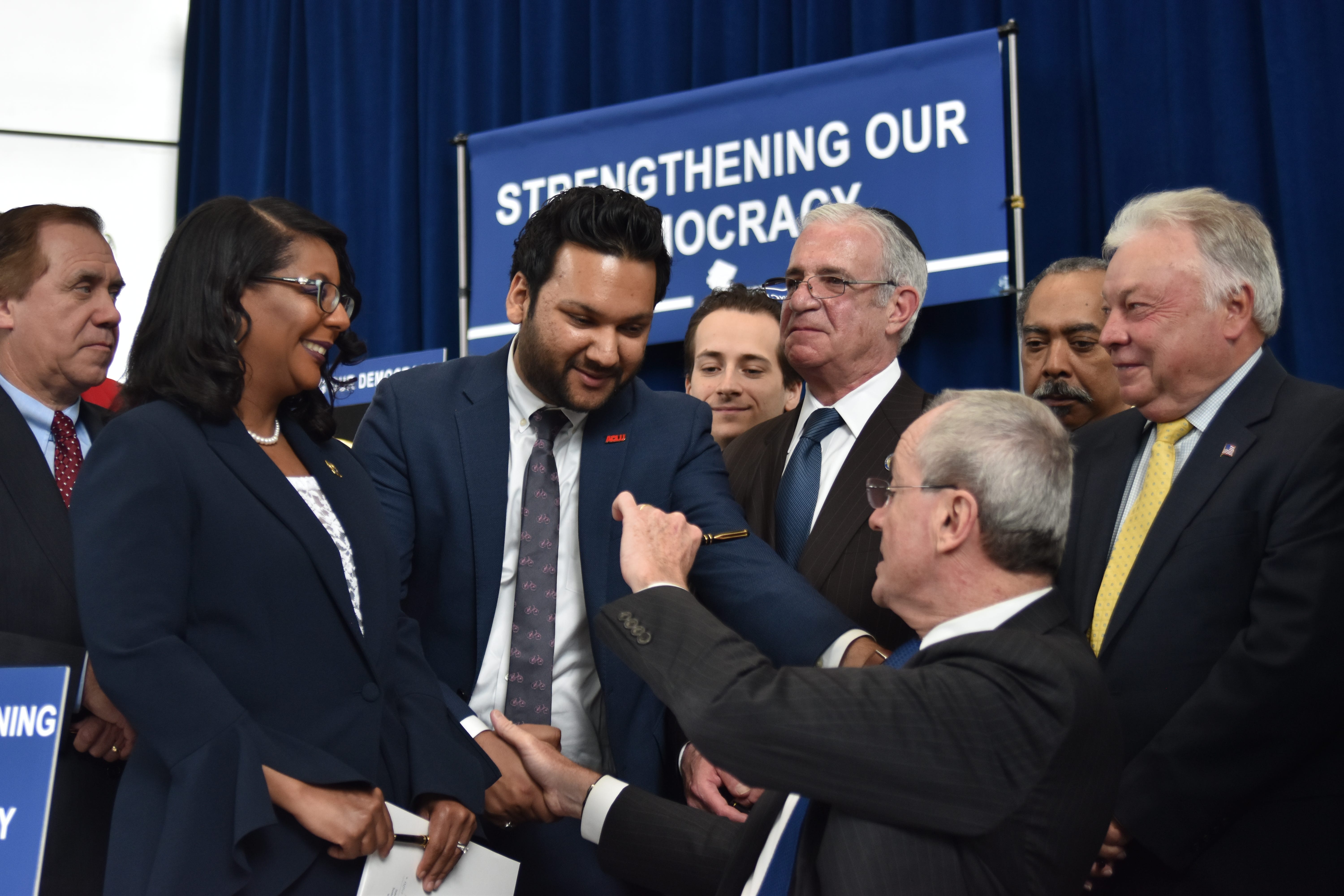
Q. You have led ACLU-NJ since 2017, and your entire career speaks to serving the public interest when many lawyers tend to gravitate toward private sector life. Following law school, why did you decide to pursue your path in public interest?
Amol Sinha: I interned for ACLU National in law school working on national security, First Amendment, and human rights issues and I was sold. It’s not only that I wanted to work in public interest, I knew that I wanted to work at the ACLU and focus my career on defending civil rights and liberties. I found the work of the organization incredibly compelling, and was particularly drawn in to its nonpartisan and principled approach. The ACLU works to hold government accountable, regardless of political party or who is in the White House. We’ve sued every president since Woodrow Wilson and we will continue to do so throughout our existence.
I was also attracted to the ACLU’s scope and approach – it is truly a multi-issue, multi-tactic organization. From early on in my career, I saw litigation as one tool – not the only tool – to achieve change. The ACLU’s model of integrated advocacy – using multiple strategies in harmony, including impact litigation, legislative advocacy, community organizing, strategic communications, and more – spoke to me as a more holistic approach. The theory is that no one strategy is going to achieve the durable wins we need, but perhaps a constellation of strategies in concert will bring us closer.
Q. In recent years, you and ACLU-NJ have been in the crosshairs of so many important public policy debates in New Jersey. How do you decide which areas to focus on, especially in these charged times?
Amol Sinha: It’s the hardest part of the work. We are constantly evaluating potential cases, legislative campaigns, and other initiatives. Our mission is expansive and so is our work – we have to be disciplined in our approach so that we are not constantly overwhelmed. There are many ways we make decisions about priorities, and sometimes the urgency of the moment dictates. Right now, we are seeing rampant abuse of power, a violent mass deportation agenda, and the erosion of the rule of law and our democracy – so we’re firing on all fronts. Consistently, we look to whether an issue falls under our mission, whether we are the right voice, and whether it would actually deliver change. Another way we look at the work is a calculation of our expertise, opportunity, and impact. Ideally, our priorities fall at the middle of that Venn diagram.
Q. One of those areas has been voting rights. In the New Jersey Legislature, your organization and so many others have been pushing for the passage of the John R. Lewis Voter Empowerment Act. If passed, the bill would - among other things - protect against voter intimidation, empower voters to protect their right to vote in court, and expand language access for voters. Unfortunately in the last legislative session, while it made progress, and despite a strong list of supporters, it did not cross the finish line to passage before the session ended. But recently, we’ve seen a promising development when an Assembly committee voted to advance the bill. As we approach the midterm election in the coming months, why is this bill important for New Jersey to pass?
Amol Sinha: The right to vote is fundamental to our democracy. When people think about who it is that is being disenfranchised in our country, they usually think about people in southern states or “red” states. They rarely think about New Jerseyans. However, there are many ways in which New Jersey is susceptible to disenfranchising voters in our state, and that disproportionately impacts voters of color. If we want to, we can be the gold standard for democracy. As the Trump administration tries to erect barriers to voting, especially as we approach the midterms, it is all the more reason we need to make sure New Jersey is doing whatever we can to protect voters.
Q. At the national level, we have heard press reports about federal enforcement actions at an election office in Georgia and the demand from the Attorney General of the United States for Minnesota election records.7 Congress is also considering the SAVE Act, which would, among other things, impose citizenship documentation requirements on voters. How does the broader political context affect, if at all, how the John R. Lewis Voter Empowerment Act is viewed in New Jersey? Does the New Jersey bill have anything to do with partisan politics?
Amol Sinha: In addition to the other issues you cite, the Trump administration is going after voter files in many states, including right here in New Jersey. They are seeking the full, unredacted voter file which contains sensitive information including dates of birth, social security numbers, and more, without explaining what it is that they intend to do with the information. Not only is this a serious threat to privacy, it can be used to justify unjust challenges and purges of records, potentially leading to the disenfranchisement of scores of people, especially vulnerable voters including voters of color and voters who are naturalized citizens.
We’re fighting back across the nation by intervening in litigation in those cases on behalf of organizations and voters. I am proud that we just filed a motion to intervene here in New Jersey on behalf of civil rights and civic engagement organizations and individual voters in our state.
I know we are living in increasingly polarized times. However, guaranteeing a robust democracy has nothing to do with partisan politics. People across the ideological spectrum support the right to vote, and my hope is that we will have wide, bipartisan support for the John R. Lewis Voter Empowerment Act.
Q. What would be your message to lawmakers in New Jersey about this bill?
Amol Sinha: The time to act is now. As the Supreme Court of the United States is poised to further dismantle the federal Voting Rights Act, and in the face of existential threat to our democracy, states must lead the way. New Jersey has the opportunity to take a bold step, empower our residents, and embrace democracy.
Whether in New Jersey or on the national stage, count on more developments in the election and voting realm as we inch closer to Election Day. Many thanks to Amol for his time and sharing his insight with us.
Stay safe, and stay engaged.
Before then, the states will be holding primary elections. This past Tuesday, three states (Texas, North Carolina, and Arkansas) held their respective primaries. Out of the three, Texas gained outsized national attention for its U.S. Senate race.
A quick civics lesson. The U.S. Constitution prohibits “nationalizing” the vote. Both the states and Congress have a role in conducting federal elections, with the states invested with the “responsibility for the mechanics” of federal elections, “but only so far as Congress declines to pre-empt state legislative choices.” And both are subject to constitutional limits.
Another civics lesson. The President does not have unilateral authority to impose voting requirements in the absence of legislation. In March 2025, the President - through executive order - sought to require “documentary proof of United States citizenship” for the national mail voter registration form. The executive order is subject to litigation, and so far, federal judges are unpersuaded with the President’s power grab: “Because our Constitution assigns responsibility for election regulation to the States and Congress, this Court holds that the President lacks the authority to direct such changes.”
In his most recent State of the Union address before Congress, the President maintained the drumbeat to pass the SAVE Act.
In this newsletter, all roads lead to New Jersey.
Interestingly, the bill would remove the New Jersey Attorney General’s ability to represent county election boards, which has been the arrangement for decades. As a young litigator in the Attorney General’s Office many years ago, I would routinely represent county election boards on election day.
As mentioned above, the Justice Department is also demanding that New Jersey turn over its voter data.