

Welcome to New Jersey Insight, a periodic newsletter to make law and politics (through a New Jersey lens) more accessible.
Two months ago, I wrote about the escalating tensions between the United States and New Jersey in the area of immigration. I observed that the conflict between the two sovereigns “has had a cascading effect across the state,” ranging from a widespread political backlash on the local level to the enactment of new policies at the state level along with the filing of more lawsuits.
Now, the epicenter of that conflict has fallen on Delaney Hall in Newark, New Jersey. A federal immigration detention center overseen by U.S. Immigration and Customs Enforcement (ICE) and run by a private company called GEO Group, Inc., Delaney Hall holds approximately 300 detainees. Widespread allegations of detainee mistreatment, including a hunger strike, have engulfed the facility.1 New Jersey’s congressional delegation has endeavored to exercise its oversight authority with mixed results, and state and local elected officials continue to spotlight the ills at the center with calls for accountability.
Since Memorial Day weekend, protests have erupted. During one episode, federal officers deployed pepper spray on the protestors in near proximity to U.S. Senator Andy Kim. This past weekend, after the New Jersey State Police secured an agreement to control an area outside of Delaney Hall to allow protest activity, more clashes occurred between protestors and law enforcement. Fires, airborne projectiles, and the use of barricades dominated. On Sunday morning, Newark Mayor Ras Baraka issued an emergency overnight curfew in the half-mile vicinity of Delaney Hall. Both New Jersey Attorney General Jennifer Davenport and Governor Mikie Sherrill appealed for calm, with the Governor not wanting to “give ICE an excuse to surge into our communities.”
None of this bodes well. In the current political environment, when the incentives are mismatched, the accountability paradigm surrounding Delaney Hall has become so diffused as to leave a partial vacuum. And as nature abhors a vacuum, something will fill it.
Here, unrest, anger, and chaos have swept in.
Today, I’ll explain the diffusion of institutional accountability and oversight around Delaney Hall, which has, in part, led us here. The pressure is building, and we need a release valve. In my view, the federal government is best positioned to deliver on that release.
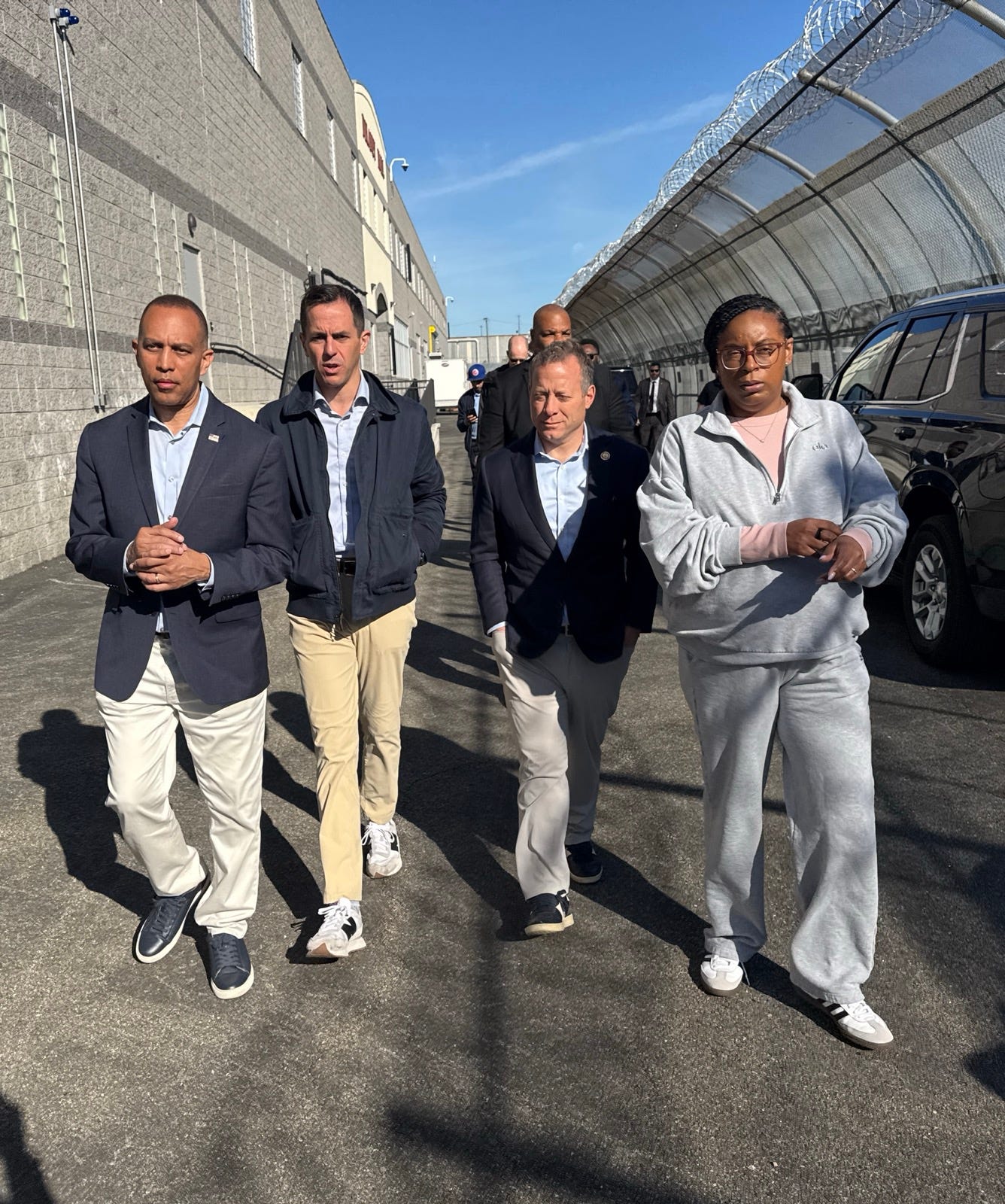
Within the federal government, the political branches could take steps to ensure oversight and accountability at Delaney Hall. Unfortunately, none have been taken, and none are expected. Conversely, the state has taken a number of steps to exact oversight, but the effect has been limited.
First, the executive branch. ICE falls within the U.S. Department of Homeland Security (DHS), which has an Office of Inspector General that is nominally charged with, among other things, investigating allegations of civil rights abuses within DHS. ICE also has an Office of Professional Responsibility, which can investigate employee and private contractor misconduct. But whether these DHS components, if they chose to investigate ICE and its contractor, would muster any confidence from the public is another question. No public indication exists that DHS has initiated any type of investigation.
Outside of DHS, one would ordinarily seek the intervention of the U.S. Department of Justice (DOJ). But with the decimation of the Civil Rights Division within DOJ and pivot away from scrutinizing the actions of law enforcement, it’s difficult to envision DOJ involvement here.
As the apex of the executive branch, the White House could exact oversight on ICE and implement a course correction, which it famously carried out a few months ago in Minnesota. It could do the same here, though at present, no signs exist that the White House wants to get involved.
Second, the legislative branch. As an institution, Congress can control the flow of money to Delaney Hall, legislate on the standards that government-contracted immigration detention centers ought to follow (or even reconsider whether to allow private detention centers at all), and investigate (with the authority to compel testimony and evidence) exactly what is happening at Delaney Hall and engage in fact finding.
I know. I’m not holding my breath.
Individual members of Congress have some oversight authority in this instance. Under current appropriations law, a federal agency may not prevent—with the use of annual appropriated funds—a member of Congress from entering a federal immigration detention center for purposes of conducting oversight.
The exercise of this authority has been mixed. Sen. Andy Kim, for example, attempted to enter Delaney Hall last week. He was initially denied, but only allowed to enter later after he called DHS Secretary Markwayne Mullin. Sen. Cory Booker has been allowed to enter Delaney Hall. Yet last year, when Rep. LaMonica McIver attempted to exercise this authority, she was met with resistance, and the scuffle led to a pending criminal indictment against her. Rep. McIver has denied the charges against her.
Third, the state. Governor Sherrill demanded entry to Delaney Hall, which was denied. The City of Newark has been pursuing claims that Delaney Hall has not complied with permitting and construction requirements that would allow it to safely house detainees. The New Jersey Department of Health recently performed an inspection of Delaney Hall, but only a “limited part” of the facility. Mayor Baraka has called on the Governor to “empower” the Attorney General to perform an immediate investigation.
Setting aside whether the Governor needs to “empower” the Attorney General to act in these circumstances, the Attorney General may be able to act independently under her existing authority. For example, the Attorney General could evaluate whether the allegations of mistreatment and assault against detainees violate New Jersey criminal or civil laws. Recall that after the horrific actions in Minnesota, the state set up an online portal for New Jersey residents to submit reports of interactions with ICE and allow the state to “hold ICE accountable for their actions, including potential violations of the law.” The Attorney General expressed her willingness, if the circumstances warrant, to pursue criminal charges against federal officers that violate state law.
Albeit in different circumstances, Minnesota has now taken this step. Prosecutors in Hennepin County brought criminal charges against an ICE agent for assault and for falsely reporting a crime. New Jersey could follow suit.
Besides a criminal investigation, the Attorney General could also invoke her authority under the New Jersey Civil Rights Act (NJCRA) and investigate whether the conduct at Delaney Hall deprived a person “of any substantive due process or equal protection rights, privileges or immunities secured by the Constitution or laws of the United States.”
At bottom, options exist for our institutions to engage in oversight and demand accountability. But these options are so diffused, and the competing incentives are so misaligned, that only delay and frustration result. Intense public pressure has incentivized state and local officials to act, but they have limited tools at their disposal. The same public pressure has not—to date— yielded the same political incentives for the federal government to act.
Nevertheless, in my view, the federal government is best positioned to lower the temperature and resolve the controversy. It can, for example, allow more transparency on the detention conditions and demonstrate through verified accounting that proper treatment with food, health care, and safety considerations in mind is in fact happening. It can engage in regular and meaningful dialogue with elected officials on the local, state, and federal level to allay any anxieties. Even if the federal government declines to alter its heavily-criticized immigration enforcement posture, a few, demonstrable steps to open the window into Delaney Hall could go a long way to relieving the pressure and frustration.
ICE largely denies these allegations. It claims that the detainees are receiving medical care and three meals a day. The agency also argues that its use of force—in response to an alleged physical fight among detainees and the obstruction of an exit route—was the “minimum amount of force necessary” to protect ICE agents and deescalate.